Storyboarding, Pitching and Drawing The Good Dinosaur at Pixar
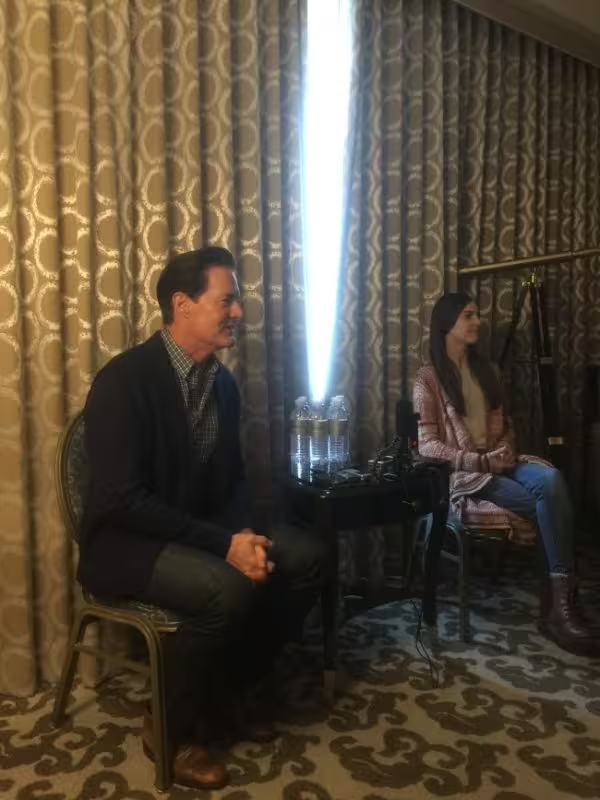
In the room at Pixar Animation Studios where The Good Dinosaur was pitched and perfected, I sat at the end of September 2015.
A long wooden executive table. Floor-to-ceiling windows overlooking the Atrium. And near the doorway, sitting on a cabinet, screenwriter Meg LaFauve.
You may know her work from Inside Out, which also came out in 2015. Here, she is talking about writing an entirely new script for The Good Dinosaur. Between LaFauve and our intimate group of maybe eight bloggers is story supervisor Kelsey Mann.
There is energy in the air. This room has history.
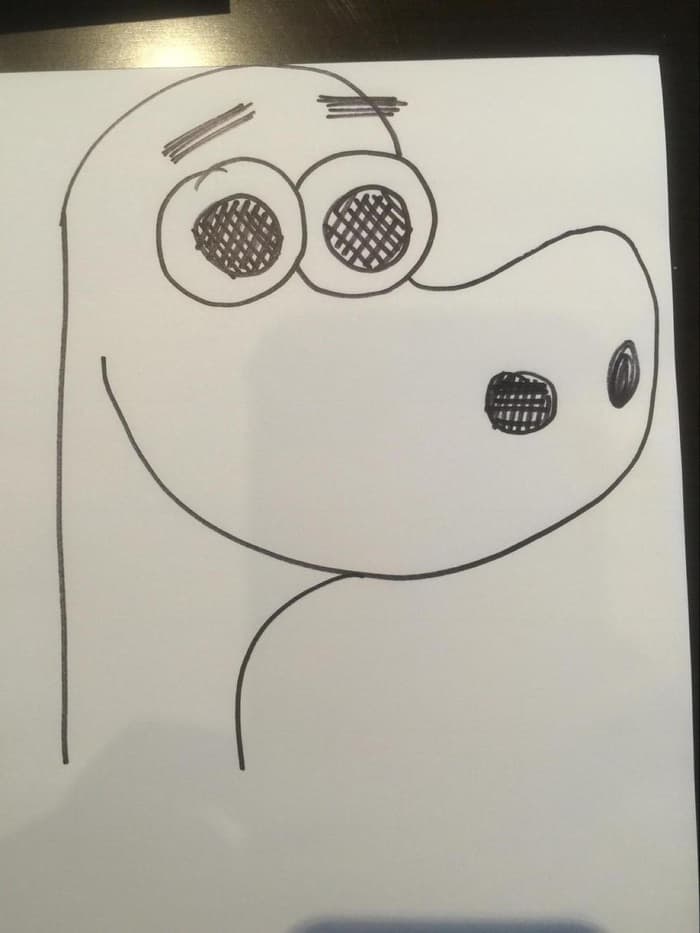
We are here to learn how written scenes become storyboards, how those drawings are pitched, and how a character comes to life. Before we leave, I’ll even have my own drawing of Arlo.
Disclosure: Disney-Pixar paid for my visit to Pixar as part of the #GoodDinoEvent.

Inside Pixar’s Story Room
The Good Dinosaur director Peter Sohn sat in one of these chairs. LaFauve, Mann, and John Lasseter gathered around this table.
Today, the room is simplified. When it was the room for creating, it looked like this:
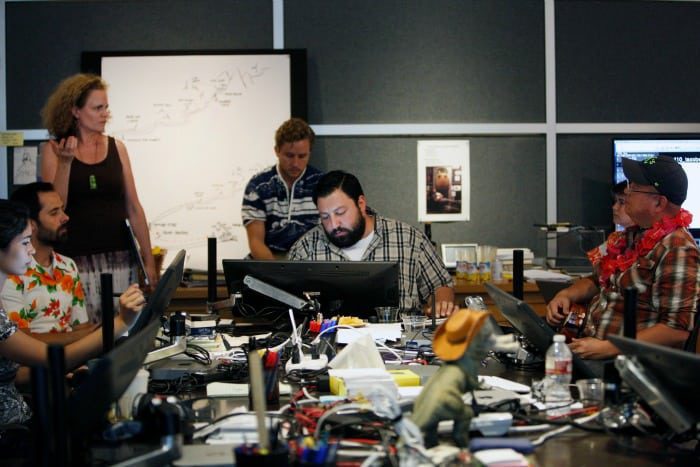
It was a room where the movie’s “charting” took place: mapping the scenes and following the characters, their relationships, and the story’s progression.
There were a lot of Post-it notes, all color-coded for scenes. Red for the intense. Blue for the emotional.
LaFauve’s role was to listen and explain how a scene would alter the storyline—for better or worse. Sometimes, that meant the Post-it notes had to be rearranged.
Writing a Story While Sharing the Vision
There is a sense of family here at Pixar. A place filled with talented artists and storytellers, and yet, with such grandeur, I’m in awe of how much they share and recognize one another.
Perhaps LaFauve explained that balance best when she talked about her role in The Good Dinosaur:
“It’s Pete’s movie, really. I have to own it just enough.”
She described needing to feel the story so she could express it on the page: finding the characters, the scene, the behavior, and the point of view. Ultimately, though, she had to let it go back to Pete and his vision.
What Is a Storyboard?
A storyboard is a sequence of drawings that shows how a scene unfolds before the final animation is created. The drawings help communicate the action, expressions, and staging so the team can see how the story works on screen.
In this room, Mann explained that the storyboarding team’s job was to translate LaFauve’s written words into the visual medium of film.
Here is a storyboard example from The Good Dinosaur. This artwork is from the sequence called “Above the Clouds”; it is a separate example from the groundhog scene Mann demonstrated during our visit.

These drawings give the team a way to explore a scene before it reaches the finished animation. For another part of that process, read about how Pixar’s animators brought Arlo’s movement to life.
Drawing Digitally—and Keeping the Collaboration
Kelsey Mann is at the end of the table, facing the wall of windows. He’s sharing a tool Pixar uses that he calls “Pitch Doctor.”
Pixar artists draw directly on the computer’s screen, replacing paper as their canvas. They can scale, flip, and erase a drawing as needed.
The old paper method had its obstacles. Draw something too small, and the artist might be starting over or running down the hall to the copy machine to enlarge it.
But Mann also explains another challenge: keeping people together.
With paper, artists could take a script and head off to their office or the Atrium. Computers opened up more possibilities, but people could still end up working separately, each behind a screen.
The compromise was a combination of the old method and the new. Line up the computers. Push the tables together. Gather the artists and storytellers in the same room.
Give them a place to bounce ideas off one another and keep the energy and excitement of a movie moving.
How Kelsey Mann Pitched a Storyboard Scene
A storyboard pitch lets the team experience a scene through its drawings and the person presenting them. Voices, gestures, and sound effects help communicate the performance while the animation is still taking shape.
One of the highlights was when Mann stepped up to the computer and showed us how a scene would be pitched.
His voice animated, booming and whispering. Sound effects. A squeaker toy.
It all made the rough black-and-white drawings of Arlo and Spot in a field of groundhogs come to life.
The chirps of those little prehistoric prairie dogs take me right back to the Pixar story room with Mann and his squeaker toy. What we experienced through rough drawings became a scene in the finished film.
My Drawing Lesson: Learning to Draw Arlo
Of course, my highlight of the day was when Kelsey Mann gave us a private, step-by-step art lesson and taught us to draw Arlo!
Here is mine!
If you enjoy these glimpses into the artists’ work, I also shared my experience during an art lesson with Disney’s Eric Goldberg.
More from My Good Dinosaur Visit
From the story room to the animation demonstrations, this visit gave me a chance to see the people and the work behind The Good Dinosaur. Mann’s pitch and that squeaker toy remain two of the details that bring me straight back into the room.
You can follow more of the experience here:
- My Pixar Animation Studios tour
- An evening around the campfire with Peter Sohn
- Walking with The Good Dinosaur: how animators brought Arlo to life
For a little movie-inspired fun at home, print out The Good Dinosaur free activity sheets.
Originally published November 23, 2015, at 9:00 a.m. Revised October 14, 2026, with clearer explanations and a refreshed image selection while preserving my firsthand experience at Pixar.