
DIY Tangrams for Kids: Printable Puzzle Craft That Builds Math Skills
Need a screen-free kids’ activity that sneaks in math practice without feeling like homework? These DIY tangrams for kids are a simple printable puzzle craft that turns one square into seven clever little shapes kids can rearrange into animals, letters, objects, and creative designs.
Tangrams are one of those classic activities that check all the boxes: low prep, budget-friendly, quiet, portable, and secretly educational. With just cardstock, scissors, and a printable tangram pattern, kids can practice geometry, spatial reasoning, problem solving, fine motor skills, and creative thinking.
Translation? It is math with a craft-table disguise. My favorite kind.
More Kids Crafts & Activities to Keep Little Hands Busy
Love easy activities that combine creativity, learning, and a little “look what I made!” magic? Explore more screen-free fun in my Kids Crafts & Activities hub, where you’ll find printable activities, simple crafts, educational games, and kid-friendly projects for rainy days, classroom centers, homeschool lessons, and weekend boredom busters.
Pair this tangram activity with Monster Math for more hands-on learning, try ABC Games for Pre-K and Kindergarten for early literacy practice, or save The Day the Crayons Quit Free Printable Activity Sheets for another creative printable activity day.
What Are Tangrams?
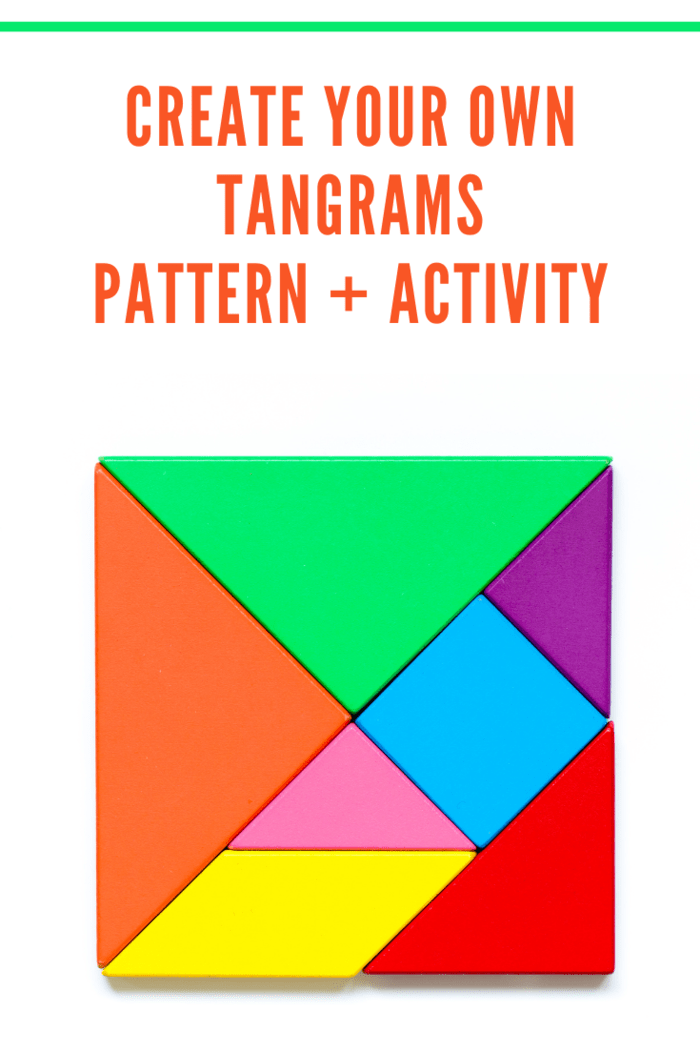
A tangram is a puzzle made from seven flat geometric pieces, often called tans. The pieces start as one square, then get cut apart and rearranged to create new shapes, pictures, animals, letters, and designs.
The challenge is simple: use all seven pieces to build a picture without overlapping them. The learning hiding inside that challenge? Geometry, visual-spatial reasoning, symmetry, rotation, persistence, and problem solving.
Why Tangrams Are Great for Kids
Tangrams may look like a simple paper puzzle, but they pack a lot of learning into a small activity. Research has connected early puzzle play with children’s spatial skills, and spatial activities are often discussed as an important foundation for later math and STEM learning.
For kids, that means tangrams can help build:
- Spatial reasoning: Kids learn how shapes rotate, flip, and fit together.
- Geometry awareness: Children explore triangles, squares, angles, symmetry, and area.
- Problem-solving skills: Tangrams encourage trial, error, persistence, and flexible thinking.
- Fine motor practice: Cutting, turning, and placing pieces builds hand strength and coordination.
- Creative confidence: Kids can create animals, scenes, letters, and original designs.
What Is Included in a Tangram Puzzle?
A traditional tangram puzzle includes seven pieces:
- 2 large right triangles
- 1 medium right triangle
- 2 small right triangles
- 1 square
- 1 parallelogram, also called a rhomboid
Those seven pieces can be rearranged into hundreds of designs. Kids can make birds, cats, houses, boats, people, letters, numbers, and their own mystery creations.
Supplies You’ll Need
- Heavyweight cardstock
- Precision craft scissors
- Printer
- Small envelope, zip-top bag, or pencil pouch for storage
- Optional: laminator or self-sealing laminating sheets for extra durability
Download and Print the Tangram Pattern
Print the tangram pattern on cardstock for the best results. Regular printer paper works in a pinch, but cardstock makes the pieces easier for kids to move, rotate, and reuse.


How to Make DIY Tangrams for Kids
- Print the pattern. Use cardstock or heavy paper so the pieces hold up to repeated play.
- Cut out the square. Trim around the outside edge first to make the puzzle easier to handle.
- Cut along the lines. Carefully cut the square into seven tangram pieces.
- Rebuild the square. Before making designs, challenge kids to put the pieces back into the original square.
- Create new shapes. Use the pieces to build animals, houses, boats, letters, people, and patterns.
- Store the set. Keep the pieces in a small envelope or zip-top bag so they do not disappear into the craft-supply abyss.


Easy Tangram Challenges for Beginners
Once the pieces are cut out, start with beginner-friendly challenges. Younger kids may need the finished picture as a guide, while older kids may enjoy working from just a silhouette.
Try asking kids to make:
- A square using all seven pieces
- A bird
- A cat
- A boat
- A house
- A rocket ship
- The first letter of their name
- A symmetrical butterfly
- A mountain scene
- A silly creature they invent themselves


Teacher and Homeschool Tips
This printable tangram activity works beautifully for classroom centers, homeschool math lessons, quiet time bins, early finisher activities, and rainy day play.
For Preschool and Kindergarten
- Focus on naming shapes and colors.
- Ask kids to match pieces to the printed pattern.
- Practice words like beside, above, below, corner, edge, and turn.
For Early Elementary
- Talk about triangles, squares, angles, and symmetry.
- Challenge kids to rebuild the original square without help.
- Ask children to explain how they solved a design.
For Older Kids
- Introduce area comparisons between the pieces.
- Have kids create their own tangram challenge cards.
- Ask them to design a picture, trace the outline, and trade with a friend to solve.
Make Your Tangrams More Durable
If you want your tangram set to last longer than one afternoon, try one of these sturdier options:
- Laminate before cutting: Print, laminate, then cut out the pieces for a reusable classroom set.
- Use adhesive foam sheets: Foam makes the pieces thicker and easier for small hands to grab.
- Try felt: Felt tangrams are quiet, soft, and great for travel or library activities.
- Add magnets: Attach magnet strips to the back and use the tangrams on a cookie sheet.
- Color-code sets: If you make multiple sets, print each one on a different color of cardstock so pieces are easier to sort.
Book Pairings for Tangram Play
Want to turn this into a full learning moment? Pair your DIY tangrams with a tangram-inspired picture book or a storytime activity. Books such as Grandfather Tang’s Story or Tangram Cat help kids connect the puzzle pieces to storytelling, animals, and imagination.
After reading, invite kids to build one character, animal, or object from the story using their tangram pieces.
More Ways to Extend the Learning
Once kids understand how tangrams work, keep the momentum going with more hands-on learning:
- Make a tangram journal: Kids can trace each finished design and label it.
- Create challenge cards: Trace finished designs on index cards for future puzzle practice.
- Use math vocabulary: Encourage words like rotate, flip, slide, angle, corner, edge, symmetry, and congruent.
- Build a puzzle station: Add tangrams to a basket with pattern blocks, puzzles, and Monster Math activities.
- Make it collaborative: Have one child build a design while another gives verbal directions.
Keep the Learning Fun Going
If your child loves printable activities and hands-on learning, keep exploring the Kids Crafts & Activities category for more creative projects. You may also enjoy ABC Games for Pre-K and Kindergarten, The Day the Crayons Quit Free Printable Activity Sheets, and Clifford Valentine Box Craft for more kid-friendly activities that combine creativity, learning, and play.
Frequently Asked Questions About DIY Tangrams for Kids
What age are tangrams good for?
Tangrams are great for preschoolers through elementary-age kids. Younger children can use them for shape recognition and matching, while older kids can use them for geometry, symmetry, area, and problem-solving challenges.
How many pieces are in a tangram puzzle?
A traditional tangram puzzle has seven pieces: two large triangles, one medium triangle, two small triangles, one square, and one parallelogram.
Can tangrams help kids learn math?
Yes. Tangrams help kids explore shapes, angles, symmetry, spatial relationships, rotation, and problem solving. They are a simple way to make early geometry feel playful and hands-on.
What is the best paper for printable tangrams?
Cardstock is the best choice because it is sturdier than regular printer paper. If you want the set to last longer, laminate the sheet before cutting out the pieces.
Can I use these tangrams in a classroom?
Yes. DIY tangrams are perfect for math centers, early finisher bins, homeschool lessons, small group activities, and quiet play. Print multiple sets on different colors of cardstock so each child’s pieces are easier to keep together.
How do I store printable tangram pieces?
Store the pieces in a small envelope, zip-top bag, pencil pouch, or plastic photo case. Label the storage container so the seven pieces stay together.
Final Thoughts: Small Puzzle, Big Learning
These DIY tangrams for kids prove that learning does not need to be complicated, expensive, or screen-based. One printable pattern, a pair of scissors, and a little curiosity can turn a simple square into a math-rich activity kids can use again and again.
Whether you are planning a homeschool math lesson, stocking a classroom center, or looking for a quiet rainy-day activity, this printable tangram craft is a clever way to build geometry skills, spatial reasoning, creativity, and confidence.
Don’t forget to pin this DIY tangram activity so you have it ready the next time you need a quick screen-free kids’ craft with a little math magic tucked inside.
Thanks for supporting Mommy’s Memorandum!
This activy was originally published September 4, 2009, and updated May 18, 2026, with improved instructions, updates, and new photos.