
Kings Dominion Moon Tree: The Apollo 14 Tree That Orbited the Moon
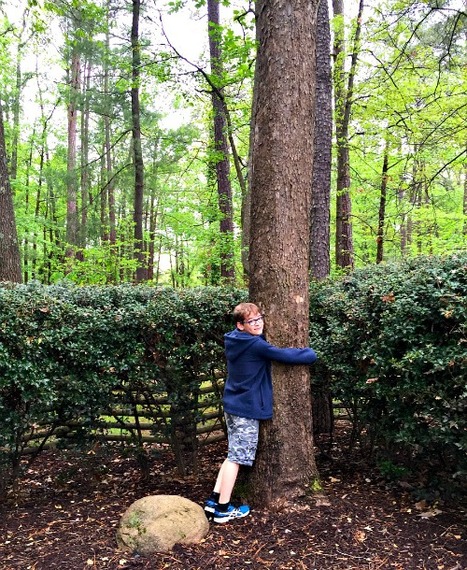
The Kings Dominion Moon Tree is a sycamore grown from one of the tree seeds carried around the Moon aboard Apollo 14 before being planted at Kings Dominion in Doswell, Virginia.
This quiet piece of NASA history stands near the park’s Eiffel Tower, giving families an unexpected educational stop between the roller coasters, food and amusement park fun.
Jump to the Kings Dominion Moon Tree
This article originally appeared in The Huffington Post on May 4, 2016.
What Is the Kings Dominion Moon Tree?
The Kings Dominion Moon Tree is a sycamore grown from one of the hundreds of tree seeds astronaut Stuart Roosa carried aboard Apollo 14 in 1971.
While astronauts Alan Shepard and Edgar Mitchell walked on the Moon, Roosa remained in lunar orbit inside the command module Kitty Hawk. The spacecraft circled the Moon 34 times before the crew returned safely to Earth.
Tucked inside Roosa’s Personal Preference Kit were seeds from several species of trees, including redwood, loblolly pine, sycamore, Douglas fir and sweetgum.
The seeds were included as part of a joint project involving NASA and the United States Forest Service. Before becoming an astronaut, Roosa had worked as a Forest Service smokejumper, parachuting into remote areas to fight wildfires.
Researchers wanted to learn whether exposure to space and weightlessness would affect the seeds’ ability to grow.
They germinated beautifully.
Those seedlings became known as Moon Trees.
Readers Also Make It a Full Kings Dominion Day
After visiting the Moon Tree, explore our Kings Dominion Virginia family guide for rides, food and attractions, or read these 10 reasons to visit Kings Dominion before planning your park day.
How the Apollo 14 Moon Trees Came to Be
Apollo 14 launched on January 31, 1971. Shepard and Mitchell descended to the lunar surface while Roosa remained in orbit aboard Kitty Hawk.
The tree seeds traveled with Roosa throughout the mission and returned to Earth with the crew on February 9, 1971.
Afterward, the United States Forest Service attempted to germinate the seeds. Most survived, and the resulting seedlings grew alongside control seeds that had remained on Earth.
The young trees eventually needed permanent homes.
Many were distributed during the United States Bicentennial celebrations of 1975 and 1976. They were planted at schools, state capitols, museums, parks, historic sites and private properties.
Moon Trees were also sent beyond the United States, including trees presented in Brazil, Switzerland and Japan.
They were not planted as a single forest. Instead, they were scattered throughout the country and around the world, each one becoming a small living monument to the Apollo space program.
Where Is the Moon Tree at Kings Dominion?
The Moon Tree is located inside Kings Dominion amusement park in Doswell, Virginia.
During our original visit, we found it in a small wooded area near the Eiffel Tower and the Old Time Photo attraction. Park layouts and attraction names can change, so ask a Kings Dominion associate for the Moon Tree’s current location if you do not immediately see it.
It is easy to walk past when you are focused on roller coasters, snacks and getting everyone to the next ride.
That is part of what makes finding it feel so special.
By all appearances, it is simply a tree standing among other trees. There is no glowing beam from the heavens, no soundtrack and no grand entrance announcing that you have arrived at something that once traveled farther than almost anything else in the park.
But this tree has been part of an extraordinary journey.
Finding the Moon Tree With My Son
When I was young, NASA seemed to be everywhere.
We watched rocket launches on television at school. Space exploration felt enormous, daring and somehow personal, even to children sitting inside ordinary classrooms.
As a junior in high school, I watched the Challenger disaster unfold. The sadness of that moment stayed with me, as did the awe I had always felt for the people willing to travel beyond our world.
Decades later, my ten-year-old son developed his own passion for space. He had even listened to astronaut Jon McBride discuss his experiences as a NASA astronaut during a focus group.
While our family was visiting Kings Dominion, my son reminded me that he had read about a Moon Tree somewhere inside the park.
Across from the Eiffel Tower, near the Old Time Photo attraction, we found a small wooded area.
Inside it stood the Kings Dominion Moon Tree.
A sycamore grown from a seed that had traveled to the Moon and back.
The Tree Was Not Marked When We First Found It
During our first visit, there was no plaque identifying the Moon Tree.
No sign explained why it mattered. Nothing told passing families that this apparently ordinary tree represented the Apollo 14 mission, the United States Forest Service and the country’s Bicentennial.
Unless you already knew the story, you could walk past it without ever realizing what was there.
I wrote about the tree because I believed it deserved to be known.
I like to believe that sharing its story helped bring attention to how special it is to Kings Dominion, Virginia and the history of the United States space program.
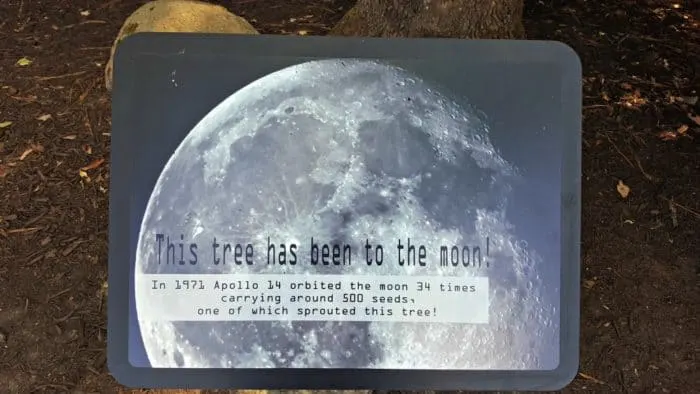
Today, the tree has a recognition plaque explaining its connection to Apollo 14.
When our family returned to Kings Dominion and saw the plaque, I became emotional. A story that had once been hidden among the trees was finally being told where park visitors could see it.
Sometimes writing feels as though you are sending words out into an enormous universe and hoping they land somewhere.
This time, perhaps they did.

Perfect With a Virginia Summer Weekend
A stop at the Kings Dominion Moon Tree fits naturally into a summer amusement park trip, a Virginia history road trip or a family lesson about NASA and space exploration. Browse more amusement parks and waterparks, then keep the relaxed summer feeling going at home with our summer recipes and party ideas.
Why Were the Apollo 14 Seeds Sent Into Space?
The seeds honored Stuart Roosa’s connection to the United States Forest Service while also giving researchers an opportunity to observe whether spaceflight affected their ability to germinate.
Roosa had worked as a smokejumper before joining NASA. Smokejumpers are specially trained firefighters who parachute into remote areas to battle wildfires.
That background made tree seeds a fitting choice for his Apollo 14 Personal Preference Kit.
The seeds were not planted on the Moon. They remained with Roosa in lunar orbit inside the command module and were brought back to Earth afterward.
What Kinds of Trees Became Moon Trees?
The Apollo 14 seed collection included five types of trees:
- Sycamore
- Loblolly pine
- Douglas fir
- Redwood
- Sweetgum
The Kings Dominion Moon Tree is a sycamore.
Other Apollo 14 Moon Trees were planted at locations that included schools, government buildings, historic landmarks and international sites. Because detailed records were not consistently maintained, some original Moon Trees were later forgotten or lost.
Why the Kings Dominion Moon Tree Matters
The Kings Dominion tree connects several chapters of American history in one living landmark.
It represents the scientific ambition of the Apollo program, Roosa’s service as both a smokejumper and astronaut, the partnership between NASA and the Forest Service, and the Bicentennial celebration during which many Moon Trees were distributed.
It is also an especially memorable piece of history for children.
Apollo missions can feel distant when they are reduced to dates in a textbook. Standing next to a tree grown from a seed that traveled around the Moon makes that history tangible.
Children can touch its bark, look into its branches and understand that something alive in front of them was connected to one of humanity’s greatest adventures.
Tips for Visiting the Kings Dominion Moon Tree
- Ask for its current location: Park layouts can change, so check with a Kings Dominion associate if you cannot locate the tree near the Eiffel Tower area.
- Read the plaque together: Give children time to read the marker and connect the tree to Apollo 14.
- Pair it with a space lesson: Before your visit, learn about Stuart Roosa, Alan Shepard, Edgar Mitchell and the Apollo 14 mission.
- Take a family photograph: A picture beside the tree makes a meaningful alternative to the usual roller-coaster photo.
- Treat the tree respectfully: Admire and photograph it without climbing on it, carving the bark or disturbing the surrounding area.
- Confirm park details: Check Kings Dominion’s current operating calendar, ticket information and policies before traveling.
Is the Original Kings Dominion Moon Tree Still Alive?
NASA’s current Moon Tree location list identifies a sycamore at Kings Dominion in Doswell, Virginia. The tree is also recognized with a plaque inside the park.
Because trees and park conditions can change, visitors seeking the most current information should confirm its status and location with Kings Dominion before making a special trip solely to see it.
A Living Reminder of Apollo 14
The Kings Dominion Moon Tree does not roar down a track, flip riders upside down or light up the park at night.
It simply grows.
Yet its roots connect Kings Dominion to the Moon, the United States Forest Service, NASA and a former smokejumper who orbited another world.
It reminds us that great things are sometimes forgotten.
It also reminds us that their stories can survive when someone notices, asks questions and takes the time to tell them.
Frequently Asked Questions About the Kings Dominion Moon Tree
What is a Moon Tree?
A Moon Tree is a tree grown from a seed carried aboard the Apollo 14 mission in 1971. The seeds traveled around the Moon with astronaut Stuart Roosa before returning to Earth and being germinated by the United States Forest Service.
Where is the Moon Tree at Kings Dominion?
The tree has historically been located in a small wooded area near the Eiffel Tower inside Kings Dominion in Doswell, Virginia. Ask a park employee for its current location because park layouts can change.
What kind of tree is the Kings Dominion Moon Tree?
The Kings Dominion Moon Tree is a sycamore grown from an Apollo 14 seed.
Did the Moon Tree grow on the Moon?
No. The seed traveled around the Moon aboard Apollo 14 but was returned to Earth and germinated here.
How many times did the Moon Tree seed orbit the Moon?
The seed traveled with Stuart Roosa while the Apollo 14 command module orbited the Moon 34 times.
Who carried the Moon Tree seeds into space?
Apollo 14 astronaut Stuart Roosa carried the seeds in his Personal Preference Kit. Roosa had previously worked as a smokejumper for the United States Forest Service.
Why did NASA send tree seeds into space?
The seeds honored Roosa’s Forest Service background and allowed researchers to observe whether exposure to spaceflight affected their ability to germinate.
Does the Kings Dominion Moon Tree have a plaque?
Yes. The tree was unmarked when our family first found it, but a recognition plaque was later installed to explain its Apollo 14 history.
Can children visit the Moon Tree?
Yes. It is inside Kings Dominion and makes an easy educational stop for families interested in NASA, science, trees or American history.
Moon Tree Resources
- NASA: Apollo Moon Trees and Known Locations
- NASA History: Moon Trees
- collectSPACE: Apollo 14 Moon Trees 45 Years Later
Final Thoughts on the Kings Dominion Moon Tree
The Kings Dominion Moon Tree may never be the loudest attraction in the park, but it remains one of the most meaningful.
It grew from a seed that crossed the darkness of space, circled the Moon and returned home. It honors an astronaut, a firefighter, a scientific experiment and a country celebrating its Bicentennial.
Most of all, it proves that an apparently ordinary tree can hold an extraordinary story.
Sometimes we simply need someone to point it out.