
Animation is a fascinating world. While in Los Angeles earlier this month, I joined 24 amazing bloggers, around the table at DisneyToon Studios to talk Tinkerbell and the Neverbeast with animators RYAN GREEN and MIKE GREENHOLT.
They were honest with the process and much of it is what most of probably imagine, according to Green, they “discuss the story, then run away to computers to draw, draw, draw.” After much drawing they “come back with all the panels and put them on the screen, look at them and say, ‘Is this working?’.” The reality is, Green continues, “it never works the first time, or the second or the third. We draw out about four or five full movies before we send it off to animation.”
Green’s role in Tinkerbell and the Neverbeast was Fawn and the Neverbeast’s relationship moments. He admits, “Fawn knows every single animal in Pixie Hollow, except for one, and it’s Gruff. When we started our movie we didn’t really know who he was either.”
Fun Fact: In the original drawings Gruff didn’t have a tail, he had horns.

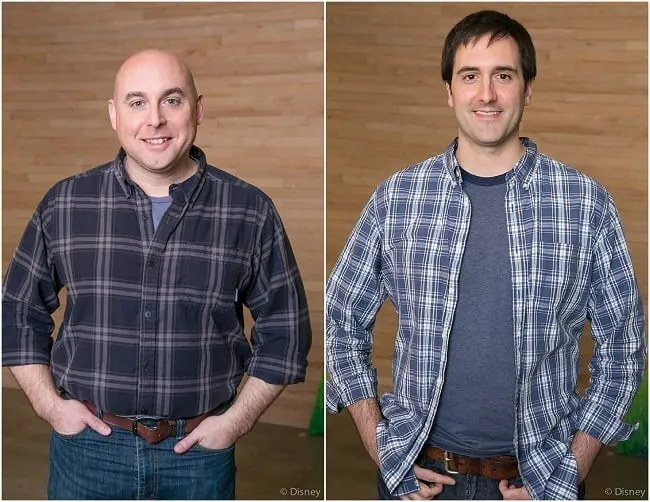
Mike Greenholt (L) and Ryan Green (R) talk about the animation behind Disney’s Tinkerbell and the Neverbeast! photo courtesy of Disney
Then Green shared something about himself. “A little fun fact about myself is that, before I got into art, I actually had a degree in biology, so I was able to kind of inform the discussion on how his animal is built and what’s inside all that fur.”
He then shows us initial overlays where he’s added the skeleton of arms and where muscles would be. With some story artists drawing Gruff with a hump in the back (like a cat where it might be an arched back) and others drawing Gruf more like a bison. They had to determine what kind of animal they were basing Gruff on.
Green shares some interesting biology facts: “What’s interesting is that a carnivore has a very flexible backbone, if you think of like cats and dogs. And so if a cheetah runs, you know, they- it flexes up and down. Herbivores, because they eat a lot of plant material, their digestive system is huge and we have to keep that weight up, they would have a very few straight backbones. So the hump on the back of a bison is actually just a lot of tall spines coming off the spinal cord.”
Green continues, now talking biology and how it plays a part with Gruff, “For purposes of our movie, we wanted to have that surprise in act three, where the something comes out of the body, the secret weapon in a way. We basically decided it would be best to mount that on the back of like a bison type character. Once we were set on that, we were going to go with herbivore as, the basis for this (character), We went to the zoo, and we looked at different animals for inspiration. Some of those were the rhinoceros and the hippopotamus. We were looking at if you stare at them from the front, you can see they have this big giant body. “

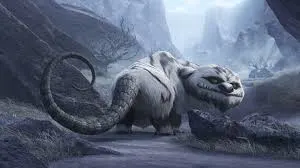
©2014 Disney Enterprises, Inc. All Rights Reserved.
“Then underneath, almost like a wine glass, their legs are very close together, or- very close to the center of gravity, that’s to support all the weight. Basically, an animal like this would go left left right right, left left right right.”
So with all this gathering of information, they concluded they would go with an elephant type leg, where there’s a long thigh and long calf and then a really short foot. They eliminated the pad from the foot, decided Gruff would have toes that would be used for digging up rocks and in the end, the foot is more of a hippo slash cat type of foot.
Green details the tail of Gruff, “The tail we based on animals like the prehensile tail porcupine. If you’ve ever seen one of those, they can just basically wrap their tail around a log, and support themselves, almost like an extra hand.
Fun fact: “Initially, we thought of keeping the tail wrapped under the body and then just bringing it out as a surprise, but it looked a little funny, almost like a shamed dog so we decided to just leave it out moving around all the time. ”
It’s more than a tail for Gruff, Green shares, “His tail is important is for emotion, because we had these big glass eyes. And they don’t show as much emotion as a human eye would, so we were able to see how he’s feeling through his tail. If anybody has a cat here, you know that when they get angry, the tail starts twitching, so we took advantage of that. We wanted to make the character really bizarre and otherworldly.”
Fun Fact: “We had initially started with a bunch of shark teeth. We thought, let’s give him some kind of menacing shark teeth.”
Turns out shark teeth aren’t the best fit for biting and chewing snide-grass sap, so they added some molars. They did keep the bizarre-ness with many rows of teeth. In the movie we also see Gruff kind of like a chameleon that has his tongue spitting out.

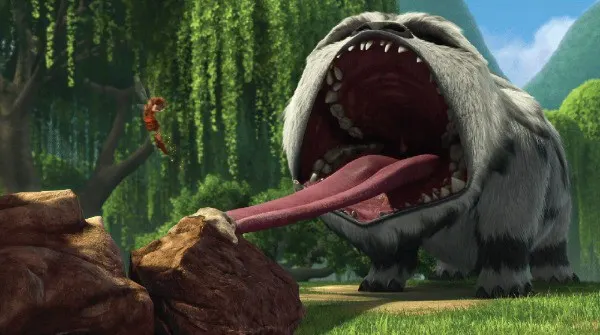
©2014 Disney Enterprises, Inc. All Rights Reserved.
Then Mike Greenholt,talked about the, the animation process that the animators went through after the initial research.
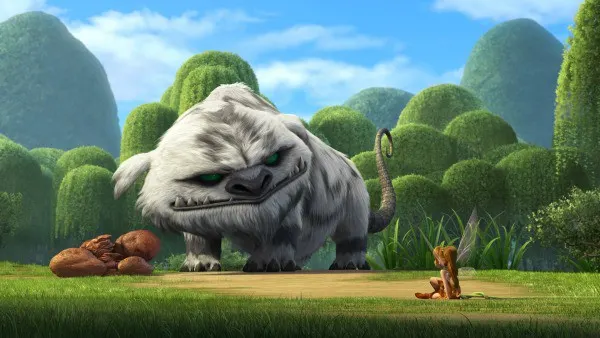
Greenholt begins, “At this point we have a lot of great research that came from the story department, but we had to bring Gruff to life. Our big challenge was, even though he was a fantasy creature, he had to feel like a real live animal. Where we started with that was just with a walk. We went to the zoo, we looked at video footage of a rhinoceros and how they walk. A rhinoceros has a great big head like Gruff does, so, how does that head move up and down, what makes him feel heavy?”
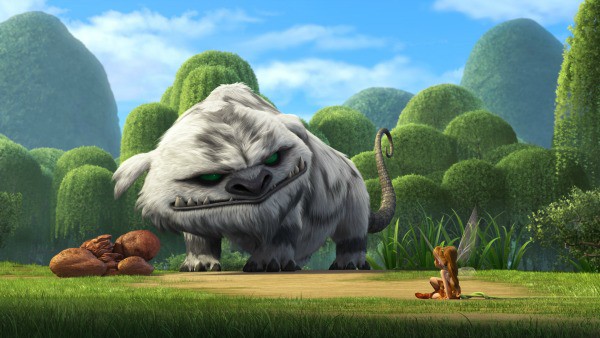
©2014 Disney Enterprises, Inc. All Rights Reserved.
“We began to apply the research to Gruff. We know he’s going to run, so how do we do a run? We wanted a run that felt like a rhino charge, but also that feels similar to a puppy sometimes too. When he’s chasing Fawn and she’s leading him through the forest, it’s almost like a game. We wanted something that was a little more playful. We’re combining both of these just to try to get something that feel- fits the character but also feels like a real live huge animal.”
“That was the first challenge. The second challenge was, how do we make him act? The last thing we wanted was for Gruff to feel like a man in a costume or like someone wearing makeup that you can tell there’s a human behind the face. So we looked at animals and how malleable is their face? What parts move? What makes it different from a human? We wanted to keep it limited.”
“We also knew we had to deliver a very emotional performance, so we have these limitations but how can we make a scene that’s touching or moving? An inspiration that I found was my dog. Just living with an animal, you start to see facial expressions, and you read things into it. When my dog wants to go outside, she puffs her cheeks out and there’s body language changed. She wags her tails, the eye darts, the brows are very expressive. You can tell, she’s trying to tell me something.”
“When I ask, “do you want to go outside?” she knew exactly what I meant. You see Fawn do that. She talks to Gruff, Gruff understands her. How do we show that registration? We gave a lot of controls around his eyebrows, because as a dog looks around, you don’t see the white of their eye as much, you see the brows move back and forth with the eye darts. He could look from side to side and we register those movements.”
Fun Fact: More than forty animators came together to create the movie Tinkerbell and the Neverbeast.
©2014 Disney Enterprises, Inc. All Rights Reserved.
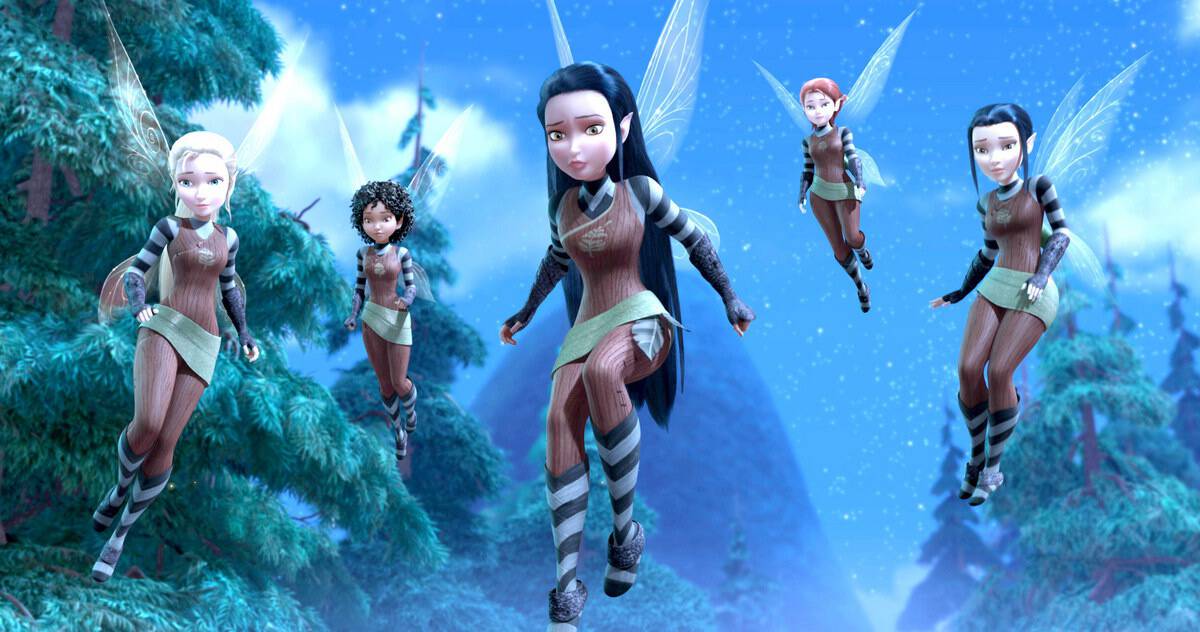
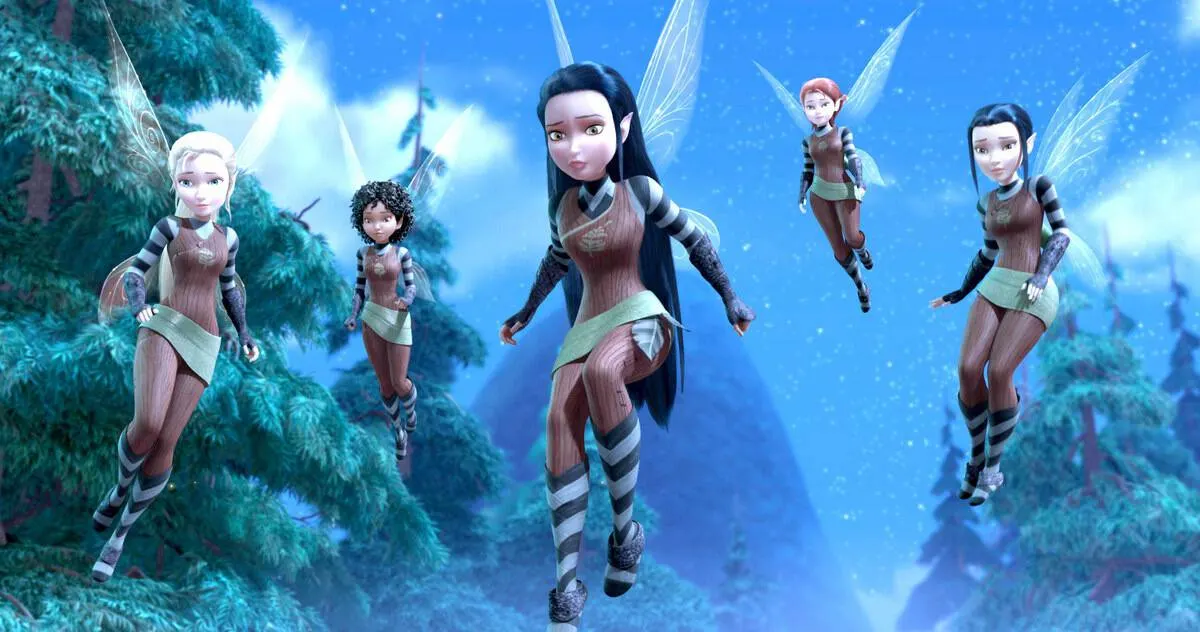
New to Pixie Hollow are the Scout Fairies. Greenholt shares his thoughts on the new characters, “The scout fairies were new in this movie, we didn’t have them before and they were cool, because they were like action heroes! They’re tough, they’re brave, they’re more athletic. The fairies that we’ve seen in other movies are more influenced by ballet or gymnastics and they’re graceful and like figure skaters. But the Scouts, we were looking at Parkour, Olympic athletes, pole vaulters, long jumpers, that really are active. That was a big inspiration for how those characters moved.”

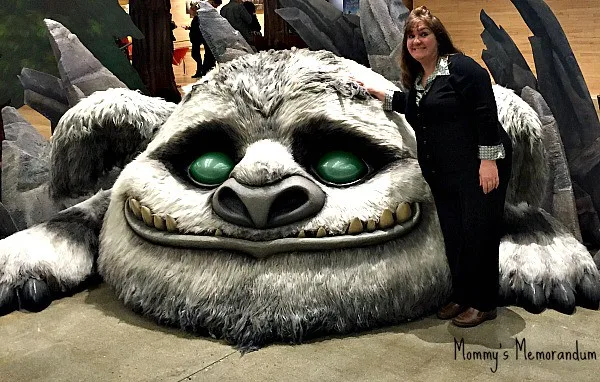
Gruff has some seriously green eyes. There’s a reason for this and Greenholt fills us in, “His eyes are green and that connects to the comet-It shows that it not only wakes him up but that there’s a connection between the two of them.”
Green expands more on Gruff’s eyes, “There was an image early on that, uh, that the director had come to the table with and it was this concept of, it was one of the images I had up there of the big eye as almost this glass ball and Fawn looking into it and seeing herself.”
“That was something we wanted to keep to the final stage so it’s this mysterious eye you don’t know what he’s thinking behind. You get some emotions through the other aspects, but it’s definitely more of a bizarre kind of eye.”
Fun Fact: All in all, start to finish, it took about three and a half years for Tinkerbell and the Neverbeast to be completed.
Fun Fact: Gruff was a temporary term, the Director Steve Loter, used and it stuck.
Fun Fact: In animation, all the voices are recorded first. The voice cast is the audio as the springboard for what is animated. As sequences are done, the animators start animating them.
TinkerBell and the Legend of the Neverbeast
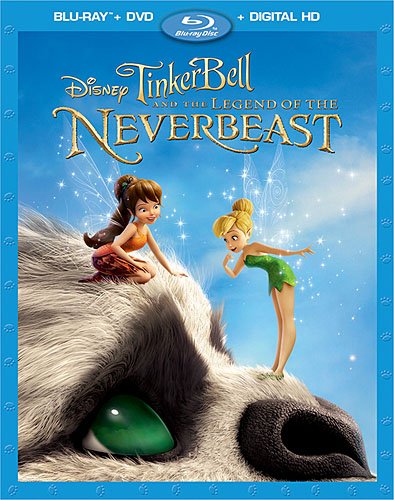
Return to Pixie Hollow for the heartwarming adventure, Disney’s Legend of the NeverBeast. An ancient myth of a fabled creature sparks the curiosity of Tinker Bell and her good friend Fawn, an animal fairy who’s not afraid to break the rules to help an animal in need. But this creature is massive and wondrous with glowing green eyes and is not welcome in Pixie Hollow, and the Scout Fairies are determined to capture the mysterious beast, who they fear will destroy their home. Fawn, who sees a tender heart beneath his gruff exterior, must convince Tink and her fairy friends to risk everything to rescue the NeverBeast.
On Blu-ray and Digital HD March 3, 2015
Follow TinkerBell: Facebook | Twitter | Website
#Neverbeast #NeverbeastBloggers